



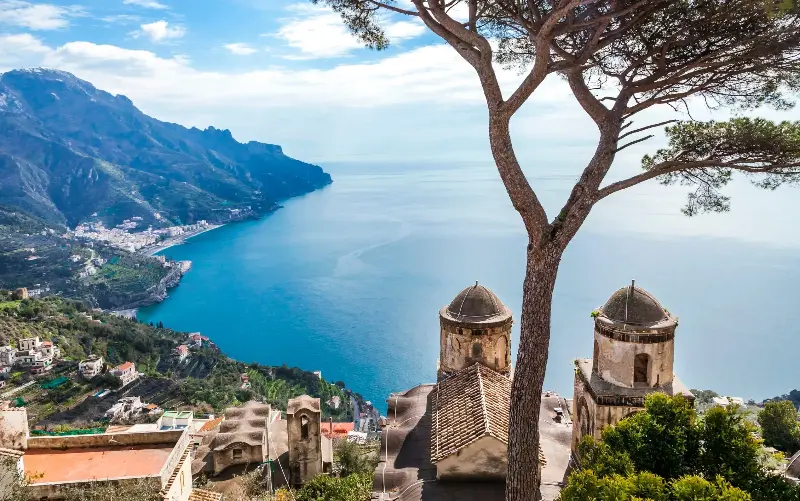
For decades, the village of Ravello, known as the jewel of the Amalfi Coast, was coveted as a secluded refuge for European and American VIPs.
Perched on a hilltop 1,200ft above the sea, its reputation for being hard to reach has long been part of its gilded charm – some visitors came up steep paths by mule to visit the enchanting villas overlooking the Mediterranean.
But with the arrival of tourist buses came traffic jams on the narrow, winding roads and an influx of visitors flooding the Piazza Vescovado.
That was not all bad news. Competing for business with the bigger, more better-known towns of Amalfi and Positano, Ravello embraced the daily coach trippers.
But in 2023, a tourist bus broke through the parapet of the road that runs along the coast to Ravello, killing the driver, Nicola Fusco, 29. He was alone on the bus.
The regional government then stepped in and banned vehicles heavier than five tons from climbing to the village.
Residents who depend on the tourists for their livelihoods are not happy.
The municipality of Ravello has opposed the ban, asking instead for urgent road repairs, speed limit enforcement and permissions for service vehicles and public transit, to salvage their summer.
Paolo Vuilleumier, the mayor, said: “It is unsustainable and doesn’t take into account the dramatic repercussions it will have on the community.
“Blocking scheduled vehicles means denying the right to mobility to students, workers and residents, as well as decreeing a total halt to international tourism that chooses our destination.”
Alessio Vlad, artistic director of the Ravello Festival, one of Italy’s most prestigious summer music and arts events, told the Corriere della Sera newspaper: “It’s all they’re talking about in Ravello. There is a lot of worry, but overtourism is also weighing in.”
Ravello has long been an exclusive destination for visitors fleeing the crowds in neighbouring Amalfi and Positano.
Actors, authors, composers and artists – from Gore Vidal to Virginia Woolf enjoyed walks in its lush gardens. Richard Wagner composed the second act of Parsifal there in 1880, and it was where DH Lawrence wrote Lady Chatterley’s Lover, in 1927.
Greta Garbo eloped to Ravello with a famous composer, while Truman Capote, Humphrey Bogart and Gina Lollobrigada filmed the 1953 comedy-adventure Beat the Devil in the central piazza. Winston Churchill and Jackie Kennedy also visited.
Notoriously difficult to reach, a narrow and windy road was built after the war that followed the route of the old “mulattiera”, or mule track.
Few who have ever driven the route can forget the vertiginous precipices, blind hairpin bends and tiny margin of error as vehicles slowly inch by one another in the tightest spots. The trek has at times ended in fatalities, such as the 2023 accident.
In the case of that accident, prosecutors later found some sections of the road failed to meet safety standards, with parapets, tunnels and shoulders in dire need of improvement by the Campania region.
The prosecutors’ findings prompted the Salerno province to issue the ordinance banning tourist buses, mini vans and all vehicles over five tons from state route 373 that climbs from the coast near Amalfi to Ravello, as well as the road to nearby Scala, until such road improvements are made.
The lines of large tour buses struggling to manoeuvre hairpin curves along the Amalfi Coast are one sign of overtourism now plaguing Italy.
A city tax was introduced to offset the impact of the large number of day trippers visiting Venice, for example, and this year the fishing village of Varenna, on Lake Como, became the latest municipality to pass a dress code to discourage visitors from walking through its streets bare-chested or wearing swimwear when entering shops, restaurants, churches and public areas in the historic city centres.
In Rome, a €2 (£1.70) entry fee was introduced this year at the Trevi Fountain to manage the high numbers of tourists lining up to toss coins into its waters.