



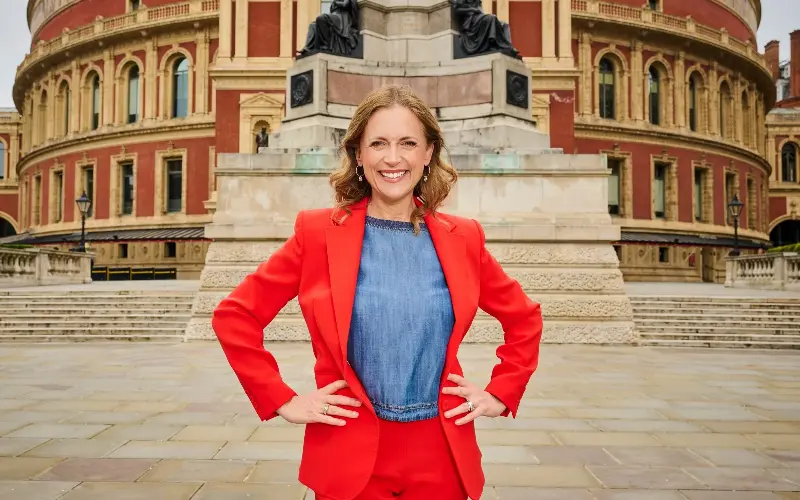
Katie Derham, 56, is one of Britain’s best-known broadcasters. She started her career in journalism at BBC News and ITN, and now hosts programmes on BBC Radio 3 and presents the BBC Proms. In 2015, she reached the final of Strictly Come Dancing, and alongside her broadcasting career, she co-founded the production company Peanut & Crumb. She lives with her husband, John Vincent, a restaurateur and co-founder of the chain Leon, and their two daughters.
How did your childhood influence your work ethic and attitude towards money?
It was a significant influence, as I’m sure it is for everybody. My parents both worked very hard. My mother was a teacher and my father was a chemist working for a pharmaceutical company.
I’m one of four children and education was incredibly important to them. They sent all four of us to private school, which meant that sacrifices were made. It meant we went on camping holidays rather than expensive trips, but they prioritised education above everything. We grew up with a very clear understanding that if you wanted something in life, you had to work hard for it.
What was your first job?
When I was 16, I worked in the summer holidays at the local department store in Wilmslow, Cheshire. I worked on the Burberry stall during what turned out to be the hottest summer imaginable. We didn’t make a sale for about 10 days straight, which must have been some kind of record. But it was great fun.
They still had those pneumatic tubes where you’d put the bill in a capsule and send it off to the cash desk upstairs and the change would come flying back down. It felt like something out of another era.
Did you always know you wanted to work in journalism?
Not really. I studied economics at A-level. My father had grown up in Brazil and travelled a lot, so there was always a sense that my life might involve travel or international work. But when I graduated in 1991, with my degree in economics from Cambridge, there weren’t many jobs around. It was quite bleak economically.
My first job was as a secretary at the Westminster Chamber of Commerce. It wasn’t glamorous, but it was a job. After about six months, I managed to secure some work experience at the BBC in Manchester, and then a job as a secretary there. Eventually I became a researcher on Money Box and other business programmes. Like most junior journalists, I spent my time opening the mail, cutting out newspaper articles and highlighting things for producers. But it was an incredible education.
Did your economics background make you good with money?
I shouldn’t laugh, but no! One of the first interviews I ever did was for a broadsheet, when I’d just started presenting Money Check on Radio 5 Live. I did the interview while my flatmate, who was an actuary and far more sensible with money than I was, stood in the background handing me glasses of wine while I answered questions about budgeting. The headline ended up being: “Presenter never follows her own advice.”
But the funny thing is that the interview led to my break in television. A few days later I received a call from a BBC film programme saying: “I hear you want to work in TV.” So, my career in television started because I admitted I wasn’t very good at managing money.
Have you ever had to choose between doing work you love and work that pays better?
Yes, absolutely. When I left the newsroom in 2010 and moved into music broadcasting, that was quite a big economic decision. We had two young children and had just moved out of London, so it was something my husband and I had to discuss as a family.
But we were a dual-income household, and we made it work. I’ve definitely taken jobs because the pay was good. And I’ve also taken jobs because I loved them even though the pay wasn’t great. If you’re lucky, sometimes those things overlap.
Did your husband’s entrepreneurial career influence you?
Yes, enormously. When he and his partners set up Leon in 2004, I saw the whole journey – the success, but also the bumps in the road and the challenges. Seeing that made me realise starting your own company is possible. It removed some of the fear.
What has been your best business decision?
Starting my media production company Peanut & Crumb in early 2015. I met Jane Gerber, my business partner, on a Sky Arts documentary. We became good friends and started doing bits of work together. At the time I was doing Radio 3 and the Proms, but also a lot of corporate events. More and more clients wanted films for their websites or branded content and I realised Jane had the skills to produce them.
And then along came Strictly...?
We’d just started the company when I received the call asking whether I’d like to compete in Strictly Come Dancing. Suddenly I was running a new business while also rehearsing six hours a day. I had the most delightful time learning to dance. It honestly felt like running away to join the circus for five months.
It was also the only time in my life, even compared with reading the news, when people would roll down their car windows and shout: “Good luck on Saturday, Katie!” which was rather lovely. My father came to the show and he was enormously proud.
What is the biggest challenge the new business faced?
During Covid-19, Peanut & Crumb had to diversify very quickly, like a lot of companies. Podcasting suddenly seemed a sensible direction to explore, so we started producing audio content for clients as well.
One of the significant shifts has been realising that you can create your own intellectual property rather than only producing content for other people. Jane had the brilliant idea during lockdown to make a podcast about birdwatching, which became “Get Birding”, hosted by Sean Bean.
Which charitable causes are important to you?
My mother had early-onset Alzheimer’s and died in her sixties, so dementia charities are very close to my heart. I work quite a lot with Dementia UK and with Arts for Dementia, which is a wonderful charity bringing creative activities to people living with the condition. I also support Music in Hospitals and Help Musicians. The transformational power of music is something I see again and again.
Do you think the UK undervalues the arts financially?
Yes, it’s something I feel strongly about. I’m a strong believer that the arts should be at the heart of every school. If children never hear a violin or sing in a choir, how can they know whether they love it? We talk endlessly about the value of the creative industries because they bring billions into the UK economy, yet we’re not investing in the pipeline of talent that will sustain them.
What’s your weakness when it comes to spending?
These days it’s probably garden centres! I’ll go in for a couple of plants and somehow leave having spent a few hundred pounds. It’s alarming. I also occasionally treat myself to facials. But garden centres are my downfall.
What does financial success mean to you?
Freedom. I think when you’ve worked in media for a long time, it’s quite hard to say no to work, partly because you enjoy it and partly because you feel lucky to be asked. But financial success would mean having the freedom to choose when to say yes and when to say no.
I love what I do, and I feel very fortunate to have access to this world, whether it’s presenting concerts or working on creative projects. But having that security would probably be the greatest luxury.