



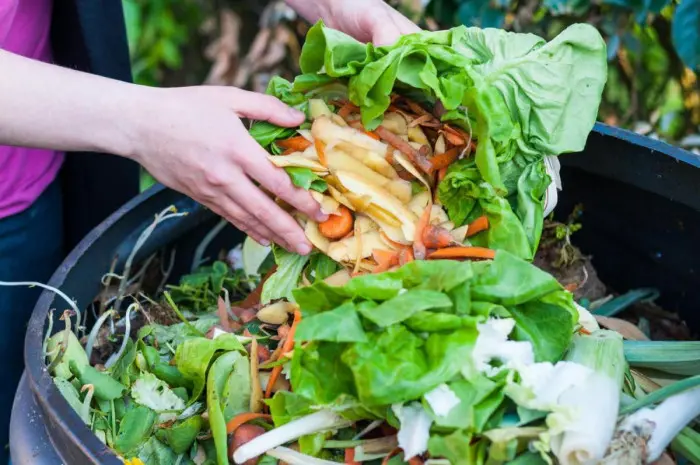
Imagine an enormous pile of leftover rice, vegetable scraps, or fruit peels dumped to landfill, slowly rotting and filling nearby communities with an unpleasant smell. But the smell is not the only problem.
When food scraps and garden waste are buried, they decompose. The process of how leftover food -- often called "food waste" -- decomposes is chemical. Without oxygen, the process releases methane -- a greenhouse gas far more potent than carbon dioxide.
In terms of carbon emission reduction, the waste sector plays an important role in the country's path towards Net Zero. Under Thailand's NDC 3.0 climate pledge, the country aims to reach net zero emissions by 2050. The emission reduction potential of the waste sector is estimated at around 4.9% of total reductions by 2035.
Even so, the waste sector receives just around 1% of Thailand's climate mitigation investment, according to estimates in our study, "Thailand Climate Finance Landscape 2025". Regrettably, the government should invest more because money put into this sector yields a higher return. Waste composting is known as a cheaper form of emission reduction. It offers relatively low abatement costs per tonne of emissions reduced.
Indeed, policymakers have high confidence in Thailand Voluntary Emission Reduction Program (T-VER) projects, particularly organic waste composting and decentralised processing schemes.
These projects are expected to reduce emissions by up to 0.42 million tonnes of carbon dioxide equivalent (MtCOeq) per year -- close to the estimated mitigation potential of around 0.5 MtCO2eq by 2035 under NDC 3.0. On paper, this suggests that composting targets could be achieved within a single year. The reality is different.
Why composting projects may fail
Waste composting has clear and instant advantages. First of all, it immediately reduces the need for land to make sanitary landfills for waste disposal and treatment, making it significantly cheaper than other waste management methods. A 2006 World Bank report estimates composting costs at just 318–1,270 baht per tonne. By comparison, composting costs are two or three times lower than sanitary landfills or producing refuse-derived fuel (RDF).
But low cost does not mean effective climate mitigation.
One major challenge is the lack of clear technical standards in the T-VER framework for household food composting. Available guidelines focus on large-scale waste separation, composting or soil amendment systems, and accounting for transportation emissions beyond 200km. What is missing are detailed technical conditions to ensure composting is done properly.
Proper composting requires an active phase of regular mixing followed by a curing period to stabilise the material. Without clear technical standards and guidance, poorly managed compost piles can generate unwanted methane gas. In that case, a project designed to reduce emissions may unintentionally become a new source of emissions.
Where the gaps lie
The way emission reductions are measured also raises concerns.
First, T-VER methodologies were developed for large-scale projects that are easier to control. Household composting, by contrast, is behaviour-driven. It depends on consistency, technical knowledge, process control, and long-term monitoring at the individual level. Using fixed assumptions may not accurately reflect real emission reductions.
In addition, T-VER methodologies assume that all organic waste would otherwise go to landfills. In reality, many communities, particularly in agricultural areas, already divert food waste for animal feed or other uses. This risks overstating emission reductions.
Second, there are weaknesses in monitoring, reporting and verification (MRV). It is impossible to monitor every compost bin in every household. To make it easier for households, the Thailand Greenhouse Gas Management Organization (TGO) should establish clear guidelines for communities.
Third, certification costs under T-VER remain high compared to the emission reduction potential at the household level. As a result, the value of carbon credits may not justify participation. This limits the ability of community-level projects to enter the carbon market.
Fourth, there is a big financial gap to fill. Thailand's NDC 3.0 targets a 12 MtCO2eq reduction from the waste sector by 2035, yet current technological capacity delivers only about 1.6 MtCO2eq -- roughly 13% of the target. According to CFNT's "Financing NDC 3.0" report, bridging the gap would require an additional 28 billion baht annually for technology upgrades and improved measurement systems. Low investment does not just mean fewer projects; it also means limited technical support, training, data systems and monitoring frameworks.
Moreover, financial returns from such projects are rarely passed on to citizens, even though they bear the main responsibility for implementation. Without tangible incentives, decentralised systems are unlikely to scale up sustainably.
What needs to change
If composting projects continue under current guidelines, Thailand risks reporting emission reductions that exist more on paper than in reality. Over time, this could erode confidence in national climate reporting. Several changes are needed.
First, clearer and more practical technical standards for household and community composting should be established to ensure projects genuinely reduce emissions. Well-defined operational guidelines -- covering aeration, curing periods and process control -- would strengthen the environmental integrity of these initiatives.
Second, T-VER methodologies should be adapted to fit decentralised, behaviour-based projects. Monitoring systems should balance credibility with feasibility, possibly through sampling methods or community-level assumptions. Without methodological adjustments, measurement risks becoming either unrealistic or unreliable.
Third, financial mechanisms must better link climate benefits to communities. Aligning composting projects with Thailand's taxonomy framework could classify them clearly as green activities, encouraging greater support from financial institutions. Without visible benefits or returns, households are unlikely to sustain long-term participation.
Poorly designed standards do more than slow implementation -- they risk weakening trust in Thailand's climate reporting itself. In an era when international climate finance and carbon markets depend on credibility, that is a risk the country cannot afford.
Parichat Suknark is a CFNT Researcher.